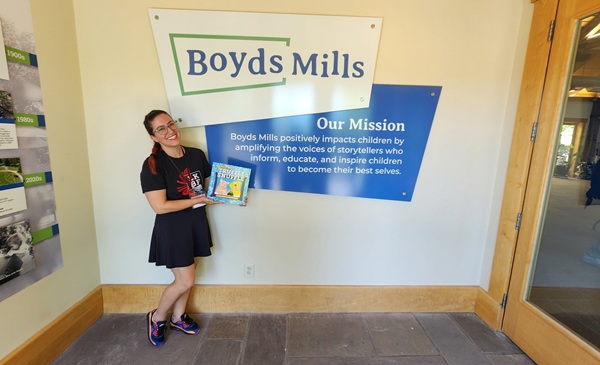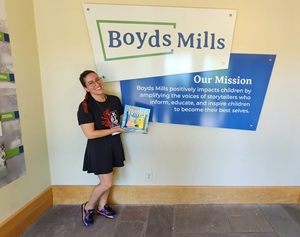
Author/Illustrator Lindsay Cordero talks with George Brown about her stories, her career, and her connections with Boyds Mills. Watch the video or read the transcript below.
More About Lindsay Cordero:
- Lindsay Cordero’s website
- Instagram: @artebybones
- Facebook: Lindsay “Bones” Cordero
- From our blog: a 2025 interview with Lindsay
“Confidence is built through experience, so how can you gain experience to build that confidence? You do it by attending the online classes. You do it by going to conferences. You do it by applying for scholarships. You do it by going to retreats. You can build confidence even just by following all of the different leading organizations within the kidlit community, because then you start to know what the layout of the relational landscape is. Step by step in the experience. Invest in yourself.”—Lindsay Cordero
Full Transcript
George Brown:
Hi! My name is George Brown. I’m the Executive Director here at Boyds Mills, Where Stories Grow. I’m so thankful to be joined by my good friend Lindsey Cordero, who is here for time #4. #4 it is?
Lindsay Cordero:
Yes, this is my fourth visit to campus.
George:
Fantastic. So I just wanted to chat a little bit about your, your time, your journey with, uh, Boyds Mills, formerly, the Highlights Foundation and just hear a little bit about your story as a storyteller. There’s a couple of pieces I want to be sure we touch on. How did you find us?
Lindsay:
Yeah, so I have always dreamed of being a picture book author, illustrator, and I actually had a commander one time–I have an Air Force background–and she asked me, Lindsay, if you weren’t in the Air Force, like what would you be doing? And I was like, oh, I’d totally be writing picture books for children. She was like, so why don’t you go do that? And I was like, you mean like right now, like I will you want me to go? Is that an order? Because I will follow it right now. And she’s like, no, get back to work. But consider like in your free time, if that’s something you dream of doing, like why not walk towards it? And that very day I went home, I Googled, I learned about the Highlights Foundation, I learned about SCBWI and I was like, OK, well, let me start learning. And it took, you know, a while, but yeah.
George:
And so then one of your first times with us was that’s the science and nature?
Lindsay:
Yeah, so. I applied for the Diversified Science Scholarship. I ended up receiving it and I was thrilled to be able to use it on the Nature and Science Illustration retreat, and I ended up bringing with me a manuscript to that retreat, very rough manuscript that I received a lot of mentorship on. A lot of guidance and a lot of feedback and I was able to eventually grow that manuscript and mature the project into what became my picture book that was most recently released, The Great Truffle Snuffle.
George:
The Great Truffle Snuffle.
Lindsay:
The Great Truffle Snuffle.
George:
What a perfect name.
Lindsay:
It was so fun.
George:
Yeah, and you were saying there was? Uh, the, the big thing you took away from that was the putting the science in the manuscript.
Lindsay:
Yeah. So what I was struggling with is like, I had gone down this rabbit hole of research, but how do you pull the story out of the research? And then how do you also include the research in a picture book format to share with the kids? And I learned about non-fiction back matter. I learned about how do you, like, bring it down to specific grade levels? How do you even learn what the different grade levels are teaching? And then how do you really identify the heart of the story? Out of everything. So I was able to learn that the truffle dogs that I met during my research were going to be the main characters in my story. And so from there I just all started to fall into place.
George:
So in brief, this is a picture book about truffle dogs, but it’s got that nonfiction science bits of it. Is it fully nonfiction?
Lindsay:
It’s a made-up story and then the back matter itself is nonfiction. There is a truffle pig included in the story, but it’s mostly dogs and it’s about two best friends, Peri and Tubs, who compete to win the Truffle Dog Championship. But some mayhem ensues when the rules change a little bit and one of them, the one that’s not a dog, has to figure out how he’s going to help Tubs compete. So spoiler alert, you know, like they find a way to win the day. But the fun thing about the story is when I do school visits, I tell the kids, I’m like all these characters that I’ve drawn, they’re based on real truffle dogs I met from the Pomeranian to the Husky. Like every single dog was a real dog. And the photos are in the back of the book, and I talked about what is a truffle? What is my mycology? How to truffle dogs hunt? So the kids get really into that.
George:
I love that you’re blending your love for science and storytelling. Tell me about Heather Montgomery. You said, you pointed over there–so folks you can’t see–but we’re on the patio. You pointed in that direction earlier.
Lindsay:
Yeah, no, I mean, this place is so magical ’cause now I, you know, this is my fourth year coming here. And so I’ve seen year after year, like all these places, I’ve learned so much from the different faculty. And like, right there during my first visit, Heather and I sat down and we talked about how to format, you know, a story including scientific information because there’s so many ways to do that for kids. You can go withh a full nonfiction route. But I still had that story I wanted to include and she encouraged me to, like, pull the threads on it. Baptiste Paul and I sat just right over there and he looked at my manuscript and it was very rhyme-y in the very first round, and he very gently guided me to consider using refrains or to unwrite the rhyme entirely, which I eventually took his advice and I did. To the benefit of the story.
George:
Is that a nice way of saying don’t do rhyming to unwrite the rhymes?
Lindsay:
Well, OK, if you want to write rhymes, that’s OK. There are some amazing books in rhyme. But I think this story was not best served for rhyme. And so he helped me kind of consider. He didn’t tell me what to do, but he was like, some stories, the rhyme serves the story and then some it detracts. And when we’re first starting out, as I was, I, you know. I thought, oh, maybe I have to lead with rhymes and I didn’t and it was very freeing, so. A lot of lessons learned on this back patio.
George:
So tell me what other workshops and retreats you’ve done here on campus.
Lindsay:
Yeah, so I came to the first Storytellers retreat, actually maybe it was the second, and received a scholarship for that as well. That was a pretty big deal to me. And I was also able to join the Illustrators boot camp last year, and that was fantastic. And I’ve brought so many projects with me to each of these and it’s interesting to continue see, like seeing how they continue to mature from all the feedback I got during those retreats. Can’t wait to see like which book is the next one…
George:
So, the Diversify Science Scholarship, our friend Lisa Schnell is kind of behind getting that started. And then I think the two of you connected?
Lindsay:
We did. Yeah. Yeah. I was so full of gratitude after receiving that scholarship. I was like, I gotta thank whoever it was. And so I think I wrote a letter to you, perhaps it was. And I was just like, I don’t know who, you know, created the scholarship, but I want to send you this note thanking them. Could you please forward it? And it was forwarded to Lisa and she and I connected. We did a blog for her Substack, which was really great. I still follow her Substack and it’s just like so soul filling to see how over like I mean, she may have never met me, you know, but she believed enough in the mission to support it in this way and it made a massive difference in my life. Yeah, I mean.
George:
Great. So much so…now tell me your career story, right? I believe you, you quit your day job to become a storyteller?
Lindsay:
OK, yes, yeah. So my background is in the US Air Force, I was a major in the Air Force. And I always knew, you know, I loved serving in the Air Force. It was an amazing experience, an amazing career, and I really did love doing it. But I always knew that the highest form of service in my lifetime would be through my art and my writing and I think we all reach a point in life where we we really have to pause and think like what direction are we, are we taking this? And if I was going to be a leader in my own life, I knew like it had I had to pivot, one of the hardest decisions of my life for sure but I don’t regret the choice I made and. Just, I mean, there’s so many ways to serve in this nation, right? I think this one is just as meaningful in so many ways. And I’m excited to be able to choose my art to connect with kids and to see them get curious about the most random things and I just right at the beginning of this.
George:
Yeah, and so you are here as the resident assistant for the Latine Retreat and uh, we have Meg Medina and Ernesto Cisneros as our hosts for this week. And then you were talking, you hosted an art art session. But tell me a little bit. You said it was great fun.
Lindsay:
It was so much fun. I think there are so many–And also this is like the first time I’ve taught art, so like I had to put a bit of brain bites into that. I was like, how do I teach this? Basically in my creative practice, I have a warm up if I’m experiencing writer’s block or I just want to, you know, start the day, there’s a collage activity I have where I collect tons of scraps of paper over over time. And I assemble them in a way that I can basically create a story. Sometimes there’s no story to be created but that I think, but as I’m assembling the scraps, that story very much comes to life. It’s a very simple exercise, 15 to 30 minutes. So I brought my entire like 4 year collection of scrap pieces of paper and laid it out on a big table and it was my gift to everyone at this retreat to just take what serves you and your practice, and then they could choose one of three adventures. If they are an illustrator, they could assemble the papers and like paint and draw on top of it to create something. Or if they’re, you know, more of a writer, there were full pages that were of various images taken from magazines and then they could write a prompt in response. And then the combined path was to use like a random paragraph very quickly select some words and then pair it with photos and create a story from that. And the whole intent of the exercise is to overcome resistance, come back to your creative process and like really detach from the stressors of everyday life and just like re-enter the creative flow so that you can start making your stories or your art.
George:
And and you described it to me like piecing yourself back together?
Lindsay:
Yeah. Yeah. I think we, you know, we go through life and we get so much of ourselves and, you know, life has so many demands on us. And it sometimes feels like you’ve outsourced yourself. And so the act of collage is very soothing, I think, because as you’re putting all of these paper pieces together like a puzzle, it’s as if you’re reassembling yourself as well. And I think when you’re able to reapproach like your joy and your wholeness in that way, you can then move directly into your creative practice. So yeah, I, it was really fun. Everyone tried it out. I was like shocked that everyone wanted to try it but everyone made such amazing art. It was incredible.
George:
All right, so tell me a little bit about your books and whether like you’ve got a couple out there and a couple in process.
Lindsay:
Yes, so I have two books that are out and I have actually have like 12 ongoing projects at any given time and I kind of like hop through them, but like there’s two that are at the most I would say advanced stages of like research and art. And then number one book I’m working on next is actually about coral restoration. So I’m a very avid scuba diver. I was actually certified when I was 12 years old.
George:
Oh, wow. That’s cool.
Lindsay:
Yes, like, this has been a lifelong passion. Yeah. And so I went to the Maldives and I was able to participate in coral restoration. And so I created an entire story from that experience. And now I’m doing an additional scuba certification for coral restoration so that I can have the research portion of the nonfiction back matter included. But the overall message in the book is to really, like, encourage kids to be aware that, you know, the PADI Bubblemakers program starts at age 8, so you can start getting your certifications at 10 or 12. So if you want to get after climate change, you know. There’s a path right there, and I don’t think many people know about it.
George:
Yeah, so here you go with the passion that you’ve had all of your life and you’re turning it into a book, which is storytelling.
Lindsay:
Exactly. Yeah. Existing at the intersection of storytelling and science. That’s what I hope to do.
George:
If we were talking to an audience of donors, I guess maybe, what would you say or how would you describe this journey or this impact?
Lindsay:
Yeah, OK. I think. If you are a donor, don’t underestimate the impact you can have in a single individual’s life. I think for me, I was so scared to be leaving my military career, to be going into–I mean, this is like, is this more than a 180?–like going from one to the other and you know, there are all these, you know, messages in society about, you know, arts and making a living. And the reality of it is like, this is a living. And if you’re a donor, you’re a part of making sure that’s the case. Every donor for both scholarships I’ve received has made such a profound impact in my life, pushed my stories forward. It’s given me the professional experience to continue growing and yeah, it’s really been everything.
George:
Let’s hope you decide that you want to commit to being a storyteller.
Lindsay:
Yeah, yeah, it really has. It’s helped me. It’s helped me develop the courage. And I don’t think we develop courage in isolation. I think we develop courage in community and I think that’s what I found here and having, you know, these scholarships and the ability to come to these retreats. Someone voting for you, someone saying, you know, I believe whatever it is you’re working on, I believe in it. And I think you should keep going. And like, that matters. It really does.
George:
We didn’t practice that part!
Lindsay:
No, we didn’t.
George:
Thats’s straight from her heart, folks.
Lindsay:
Thank you thank you for the difference you made yeah yeah.
George:
OK, so what what are you, what do you think like what are some of your next steps? You’re working on the, the coral book…
Lindsay:
Gosh, George, you’re putting me on the spot.
George:
More like general, like over the next year you’re gonna be like, you’ve gotta practice and you work every day…
Lindsay:
Yeah, I think the big thing is now, now that I have two books out and now that I’m doing school visits and now that I’m doing library visits and traveling to do these things, one thing I’m running into is how do I continually build in the time to make my next book? And so I’m gonna have to make sure I’m protecting my time throughout the rest of the year so that I can… And, you know, my goal is to have like the 20th version of I’m a Coral Gardener finished by September. I’m going to the Latinx Storytellers Conference. I decided to apply and meet with some agents. We will see.
George:
Great, yes, put yourself out there.
Lindsay:
Yeah, Yeah. So we’ll see if they are receptive to it. And if not, the search continues. And I’m sure I’ll be back here. I’d love to try a private retreat. And have very concerted time to like do my focus work. Yeah, just getting these next two books done, I think it’s going to be top priority.
George:
Thank you. Friends, this has been a lovely conversation with Lindsay Cordero, longtime friend of Boyds Mills and storyteller extraordinaire. Thank you, Lindsay.
Lindsay:
Thank you. I appreciate it and thank you so much.